
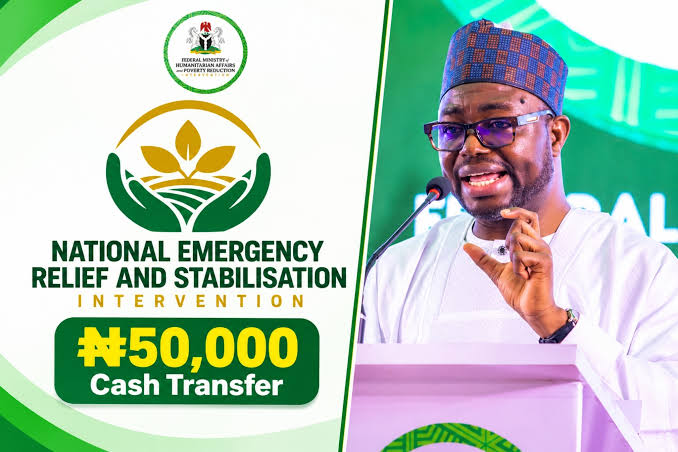
ActionAid Nigeria (AAN) has called on the Federal Government to uphold transparency and accountability in funding, beneficiary selection and disbursement of a ₦50,000 cash support intervention for poor and vulnerable Nigerians under the National Emergency Relief and Stabilisation Intervention (NERSI).
According to a Press Statement signed by the ActionAid Country Director, Andrew Mamedu, “While the initiative recognises the growing economic hardship facing millions of households, the government must provide clear, verifiable information on funding, beneficiary selection, disbursement, and accountability mechanisms.”
The announcement by the Minister of Humanitarian Affairs and Poverty Reduction, Dr Bernard Doro, on 30 October 2026, comes as Nigerians struggle with the rising cost of food, transportation, housing, and other essential services.
Direct cash assistance can provide immediate relief, but such interventions must be transparent, equitable and sustainable.
Speaking on the intervention, the Country Director of ActionAid Nigeria, Andrew Mamedu, said:
“The Federal Government has a responsibility to explain whether the intervention is funded through existing budgetary allocations, supplementary appropriations, savings from economic reforms, development financing or other sources. Nigerians deserve to know the total amount committed to the programme, how much has been released and what mechanisms have been established to ensure that every naira reaches its intended beneficiary.”
ActionAid Nigeria is particularly concerned about the absence of a clearly disclosed programme budget, specific beneficiary targets and an implementation timeline.
At ₦50,000 monthly, supporting one million households would cost ₦50 billion every month, while five million households would require ₦250 billion. These illustrative figures underscore the importance of transparent budgeting, legislative oversight and regular public reporting.
There is also an urgent need to clarify whether the ₦50,000 support is a one-off payment or a monthly allowance. While the Minister’s announcement describes it as a monthly intervention, the official programme website identifies it as a one-off grant.
The government must resolve this contradiction and explain how long beneficiaries can expect to receive support.
ActionAid Nigeria notes that beneficiaries will reportedly be selected through the National Social Register and verified national identity records.
According to the National Social Safety-Nets Coordinating Office (NASSCO), the register captures more than 20 million poor and vulnerable households. However, questions remain about when the register was last updated, the criteria for selecting beneficiaries and how newly impoverished households are being captured.
The selection process must prioritise the poorest and most marginalised Nigerians, particularly women-headed households, persons with disabilities, internally displaced persons, older persons and vulnerable rural communities.
The government must also establish accessible mechanisms for eligible Nigerians excluded from the register to seek assessment and redress. Access to social protection should not depend solely on having national identification documents, mobile phones, or bank accounts.
Mamedu further stated:
“Social protection is not a political favour or an act of charity; it is a responsibility of government to its citizens. Nigerians deserve to know who is receiving this money, how beneficiaries are selected and whether the support is reaching those who need it most. With the 2027 general elections approaching, government must demonstrate that this intervention is driven strictly by vulnerability and need, not political considerations.”
ActionAid Nigeria urges citizens to recognise that these funds are not favours from the government but part of their right to social protection.
Beneficiaries and the wider public must hold the government accountable for effective delivery of the intervention, demand transparency, and report irregularities, exclusion, diversion, or other discrepancies to relevant oversight institutions and civil society organisations, including ActionAid Nigeria.
While digital payment platforms may improve efficiency, the government must disclose how it selected payment providers, the administrative costs involved, and the mechanisms for independently verifying disbursements.
Periodic reports should show the number of households paid, total funds disbursed, geographical distribution, failed transactions and complaints resolved, while protecting beneficiaries’ personal information.
ActionAid Nigeria therefore calls on the Federal Government to:
- Publish the funding source, approved budget, total financial commitment and implementation timeline, including actual releases and administrative costs.
- Clarify the payment structure, particularly whether the ₦50,000 support is a one-off grant or monthly payment and disclose its duration.
- Make beneficiary selection transparent by publishing eligibility criteria, updating the National Social Register and providing disaggregated beneficiary targets across states and local governments.
- Establish accessible grievance and inclusion mechanisms for vulnerable Nigerians excluded from the register, alongside independent verification of payments.
- Institute third-party monitoring by credible civil society organisations (CSOs) to independently track implementation, verify that funds reach intended beneficiaries, identify irregularities and strengthen public accountability.
- Strengthen public accountability through periodic disbursement reports, legislative oversight, independent monitoring and safeguards against diversion or political interference.Beyond emergency relief,
ActionAid Nigeria urges the Federal Government to institute stronger pro-poor economic and social policies alongside ongoing social protection interventions.
Such measures must address the structural drivers of poverty, reduce the number of Nigerians falling into poverty and create sustainable pathways out of poverty for those already affected.
This requires deliberate investments in decent jobs, affordable healthcare, quality education, food security, sustainable livelihoods and other essential public services.
Social protection interventions must therefore form part of a broader, adequately financed poverty reduction strategy that not only provides temporary relief but also strengthens household resilience and economic opportunities.
The success of this intervention must be measured not by the amount announced, but by the number of vulnerable Nigerians who receive the support, the fairness of the selection process and the accountability with which public resources are managed.