
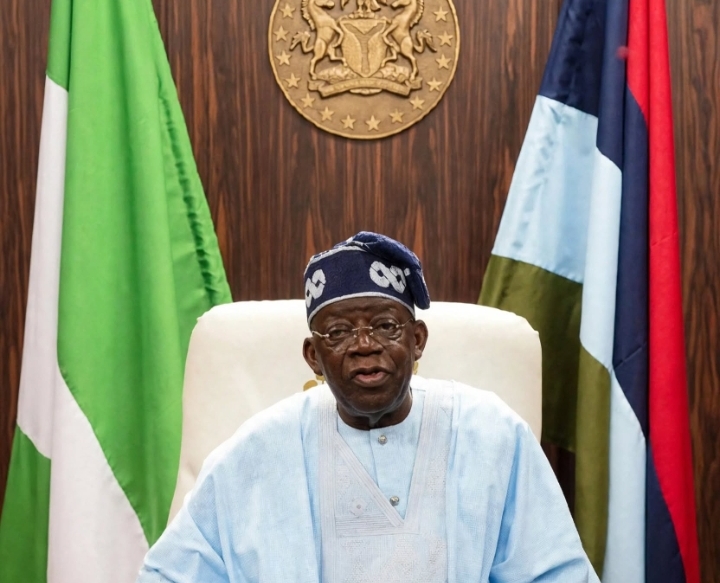
ActionAid Nigeria (AAN) has said President Bola Ahmed Tinubu’s declaration in his 66th Independence Day address that Nigeria is moving from an “age of reform” to an “age of prosperity.” is a welcome development.
However, the organization has stressed that the Federal Government must ensure these promises move beyond mere economic indicators to become a measurable improvement in everyday life, as millions of Nigerians currently struggle to put food on the table, earn a decent income, access basic services or live safely in their communities.
The President acknowledged this challenge directly, stating:
“Our objective is not to manage poverty more efficiently. We will defeat it.”That is an important commitment.
The question now is: How will Nigeria measure whether it is actually defeating poverty?
Poverty: Moving from Promise to Measurable Results. The scale of the challenge remains enormous.
According to the World Bank’s latest Nigeria assessment, an estimated 50.8% of Nigerians, about 123 million people, lived in extreme poverty in 2025, while 69.6% lived below the $4.20-a-day poverty line for lower-middle-income countries.
If poverty eradication is now a national priority, Nigerians deserve clear targets, timelines and publicly available measures of progress.
Government should be able to tell Nigerians, year by year, how many people have moved out of poverty; whether real household incomes are improving; whether fewer families are skipping meals; whether social protection is reaching those who need it; and whether access to healthcare, education, decent work and other basic services is improving.
Poverty cannot be declared defeated because economic indicators are improving. It will be defeated when people can feel the difference at home.
Economy: Growth Is Important, But Who Is Benefiting?
There are positive macroeconomic signals. Nigeria’s real GDP grew by 4.43% year-on-year in the second quarter of 2026, up from 3.89% in the first quarter, according to the National Bureau of Statistics.Inflation has also moderated.
NBS reported headline inflation at 15.39% in August 2026, while food inflation remained higher at 19.57%.These improvements matter. But growth must answer a more fundamental question: Who is benefiting
The World Bank itself notes that while Nigeria has made meaningful progress in restoring macroeconomic stability, household incomes have not fully recovered and poverty remains high.
For ActionAid Nigeria, the true test of economic recovery is whether it creates decent jobs, increases real incomes, reduces inequality, makes food and transportation more affordable, and improves public services, particularly for women, young people, persons with disabilities and communities that have historically been excluded from economic opportunities.
GDP can grow while families remain poor. Nigeria must ensure that economic growth translates into shared prosperity.Food and Agriculture: Can the Farmer Really Cultivate Safely?
The President described his vision of prosperity as a Nigeria in which “the farmer can cultivate his land safely, produce more at lower cost, and earn a decent return for his labour.”
That should become another measurable national commitment.FAO’s latest Nigeria assessment estimates that nearly 36.3 million people faced severe acute food insecurity during the June–August 2026 lean season, including about 2.1 million people facing emergency levels of food insecurity.
Conflict and ongoing economic pressures were identified as major drivers. Nigeria cannot sustainably defeat poverty while millions struggle to eat and while farmers cannot safely access their land.
The government’s commitments to irrigation, mechanisation, seeds, storage, transportation, and agricultural infrastructure are important, but these investments must deliberately reach smallholder farmers, particularly women farmers.
Nigeria must also invest more strongly in climate-resilient and agroecological farming practices that reduce production costs, protect soil and biodiversity, strengthen local food systems and reduce farmers’ dependence on increasingly expensive external inputs.Insecurity: Safety Must Become a Development Indicator
The President’s own definition of prosperity creates an important accountability benchmark: Can Nigerians farm, work, learn, travel and live safely?
Insecurity is not only a security issue; it is a poverty, food security and development issue. If a farmer cannot safely reach the farm, production falls.
When production falls, food becomes scarcer and more expensive.
When schools and markets become unsafe, poverty deepens. When families are displaced repeatedly, development gains are lost. Security therefore has to be measured not only by operations conducted or criminals neutralised, but by outcomes: Are attacks declining?
Are farmers returning safely to their fields? Can displaced families return home?
Are children attending school without fear? Are markets and communities functioning safely?
Speaking in Abuja, the Country Director of ActionAid Nigeria, Dr Andrew Mamedu, stated:
“The President has made a bold commitment that Nigeria will defeat poverty. Nigerians should now be able to hold the government to that commitment through clear, measurable results. Economic growth matters, but the real evidence of prosperity is whether a family can afford nutritious food, whether a young person can find decent work, whether a woman farmer can cultivate her land safely and profitably, and whether Nigerians can live without fear in their communities.
“If this is truly the beginning of an age of prosperity, then prosperity must have numbers, targets and timelines. We must be able to measure how many Nigerians are leaving poverty behind, not simply how much the economy is growing.”
ActionAid Nigeria therefore calls on the Federal Government to translate the President’s Independence Day commitments into clear, time-bound and publicly measurable targets for poverty reduction, household incomes, food security, employment, social protection and community safety.Nigeria should celebrate economic progress where it occurs.
But ultimately, national success must be measured by something more fundamental:
Are fewer Nigerians poor? Are fewer Nigerians hungry? Are more people earning decent livelihoods? Can farmers cultivate safely?
And can ordinary Nigerians feel the prosperity being promised?
These are the measures that matter.