
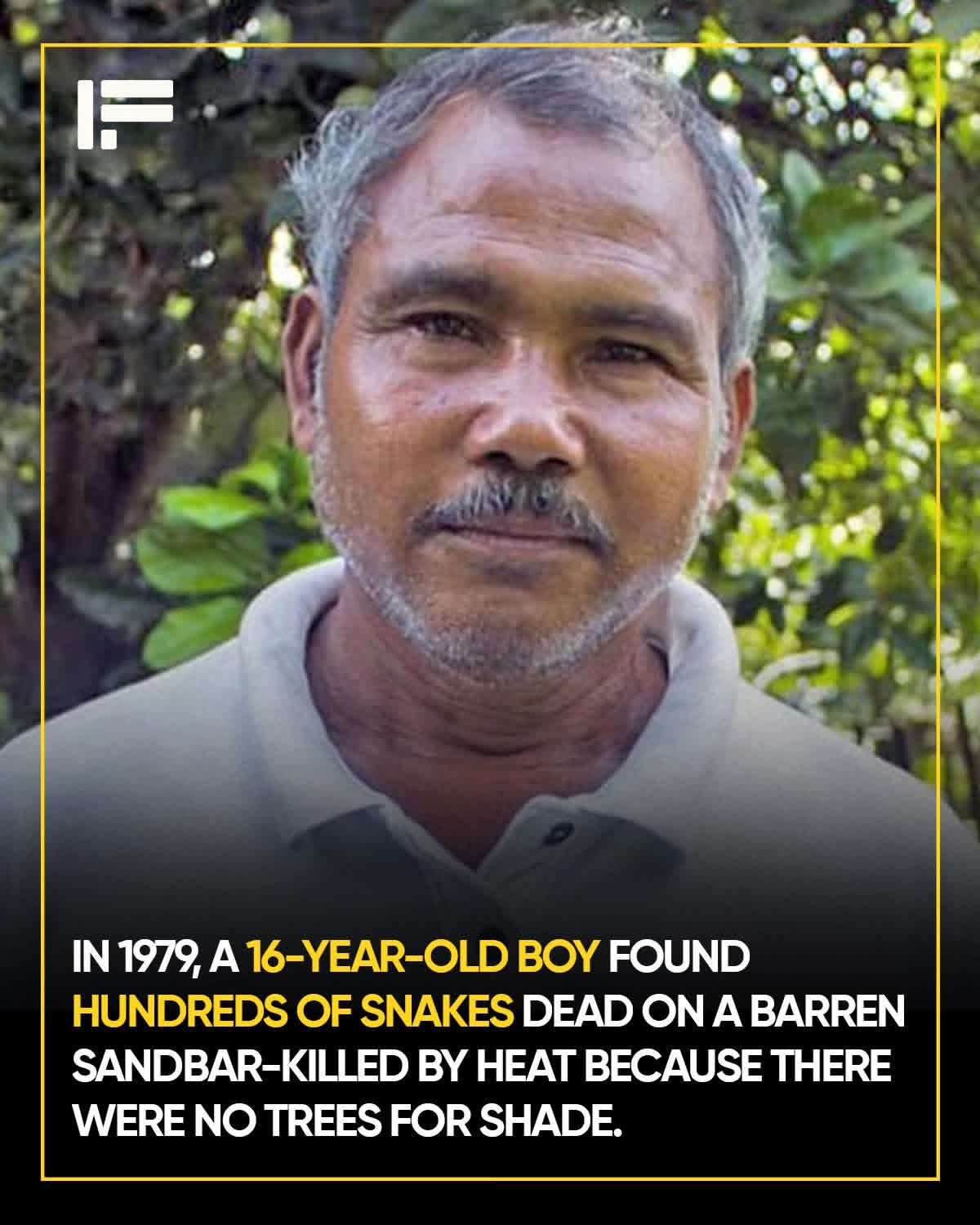
In 1979, a sixteen-year-old boy stood on a barren sandbar in the Brahmaputra River and found hundreds of snakes baked to death by the sun.
He looked at the wasteland around him and made a promise that would one day cover 1,360 acres with life.
His name was Jadav Payeng.
Majuli Island, Assam, India. The sandbar was nothing but sand and silt — no vegetation, no shade, no life. The snakes had been trapped there during floods. When the water receded, they had nowhere to hide from the scorching heat. So they died. All of them.
Jadav went to the local forestry department and asked them to plant trees on the sandbar.
They laughed. “Nothing will grow there. It’s just sand. Don’t waste our time.”
So Jadav decided to do it himself.
He was sixteen. He had no money, no formal education, no training in forestry or botany. He was from the Mising tribe — indigenous people often dismissed by mainstream society.
But he understood something the experts didn’t: if you plant trees and care for them, they will grow. Even in sand.
He started with bamboo — tough, fast-spreading, soil-stabilizing. He planted 20 saplings in a small patch.
Every day, he returned to water them, carrying pots from the river in the brutal heat, walking back and forth for hours.
The bamboo took root.
Encouraged, he expanded. He gathered seeds from nearby forests — cotton trees, banyan, arjun, moj. He planted them, watered them, protected them from animals.
Year after year. Decade after decade.
His family thought he was crazy. The village couldn’t understand why he was wasting his life on a barren sandbar. He could have been farming, earning money, building a normal life.
Instead, he planted trees. Alone. Day after day.
“What’s the point?” they asked. “It’s just sand. Nothing will ever come of this.”
Jadav didn’t argue. He just kept planting.
The bamboo spread. The trees grew taller. Their roots stabilized the soil. Falling leaves created organic matter. The sand slowly turned into earth.
After five years, the first animals appeared. Birds nested in the branches. Insects arrived. Small mammals found shelter.
After ten years, a small forest was visible. The ecosystem was coming alive — plants, animals, insects all finding their place.
Jadav kept planting.
He had no grand plan. He wasn’t dreaming of creating the largest man-made forest on Earth. He just wanted a place where animals could live. Where snakes wouldn’t die in the heat.
He supported himself selling milk from his cows. He lived simply — sometimes sleeping in a small hut he built among the trees, other times with his family in the village.
Every morning, he returned to his trees. Planting. Tending. Protecting.
Decades passed. The forest grew. And Jadav Payeng disappeared into it — living among the trees he had planted, a solitary figure the world had never heard of.
Then, in the 2000s, something extraordinary happened.
Wild elephants discovered the forest.
A herd of over 100 elephants — migratory animals whose traditional habitats were being destroyed — found Jadav’s forest and stayed. It gave them food, water, shelter.
Then came the deer. Then the rhinos. Then the Bengal tigers.
A fully functioning ecosystem had taken root on what had once been barren sand. Predators and prey. Birds and insects. A forest dense enough to support megafauna.
And at the center of it all was Jadav Payeng, the man who had planted every tree.
In 2008, a photojournalist stumbled upon the forest while investigating reports of elephants in an unusual place. He was stunned. Local officials confirmed it: the forest was roughly 1,360 acres — larger than New York’s Central Park — and it had been created entirely by one man over thirty years.
The story broke. Media descended. The “crazy” man the village had dismissed for decades was suddenly hailed as an environmental hero.
Scientists studied the forest. Conservationists celebrated it. Government officials who once ignored him now wanted to honor him.
In 2015, he received the Padma Shri, one of India’s highest civilian honors. He became known worldwide as “The Forest Man of India.”
But none of the recognition changed Jadav. He still lives in the forest. Still tends his trees. Still plants new saplings.
When asked why he did it, his answer is simple: “The snakes died because there were no trees. I didn’t want any more creatures to die like that.”
Today, Molai Forest (named after his nickname) is home to over 100 elephants, multiple Bengal tigers, Indian rhinos, deer, wild boar, hundreds of bird species, and countless smaller creatures — a complete, thriving ecosystem where there was once only sand.
One person. No money. No institutional support. No formal training.
Just commitment. Just showing up every single day for forty years. Just refusing to accept that a barren sandbar would stay barren forever.
The forestry experts said it was impossible. Nature proved them wrong — with Jadav’s help.
For thirty years, he created this forest alone, with no recognition, no funding, no support. The government that should have been protecting habitats and planting trees did nothing.
One poor man from a marginalized tribe did the work of an entire forestry department.
And when the elephants became “too numerous” (because he had created such good habitat), officials wanted to relocate them — potentially destroying the ecosystem he had spent his life building.
Jadav fought back. He told them: “They’re my family. You’ll have to shoot me before you remove them.”
The elephants stayed.
Today, Jadav is in his sixties. He still plants trees. Still tends the forest. Still lives simply among the animals he helped save.
He owns almost nothing. The forest isn’t legally his — it’s on government land. He’s never profited from it.
He just wanted a place where snakes wouldn’t die in the heat. Where animals could live. Where life could flourish.
And now, 1,360 acres of dense forest — larger than 1,000 football fields — exists because a sixteen-year-old boy saw dead snakes and refused to accept that nothing could be done.
Think about this the next time someone tells you one person can’t make a difference.
Think about this when someone says the problem is too big, the task too impossible, the world too broken to fix.
Jadav Payeng planted trees. Every day. For forty years.
And now he lives in a forest full of elephants and tigers that scientists said could never exist there.
One person. One seedling at a time. Forty years.
That’s how you move mountains. That’s how you create forests from sand. That’s how you prove that “impossible” just means nobody has tried hard enough yet.
Jadav Payeng didn’t wait for the government. Didn’t wait for funding. Didn’t wait for permission or approval or recognition.
He saw a problem. And he spent four decades solving it.
The Forest Man of India. Who created an impossible forest because he refused to let snakes die in the heat.
And now those 1,360 acres stand as proof that one committed person can literally change the landscape of Earth.