
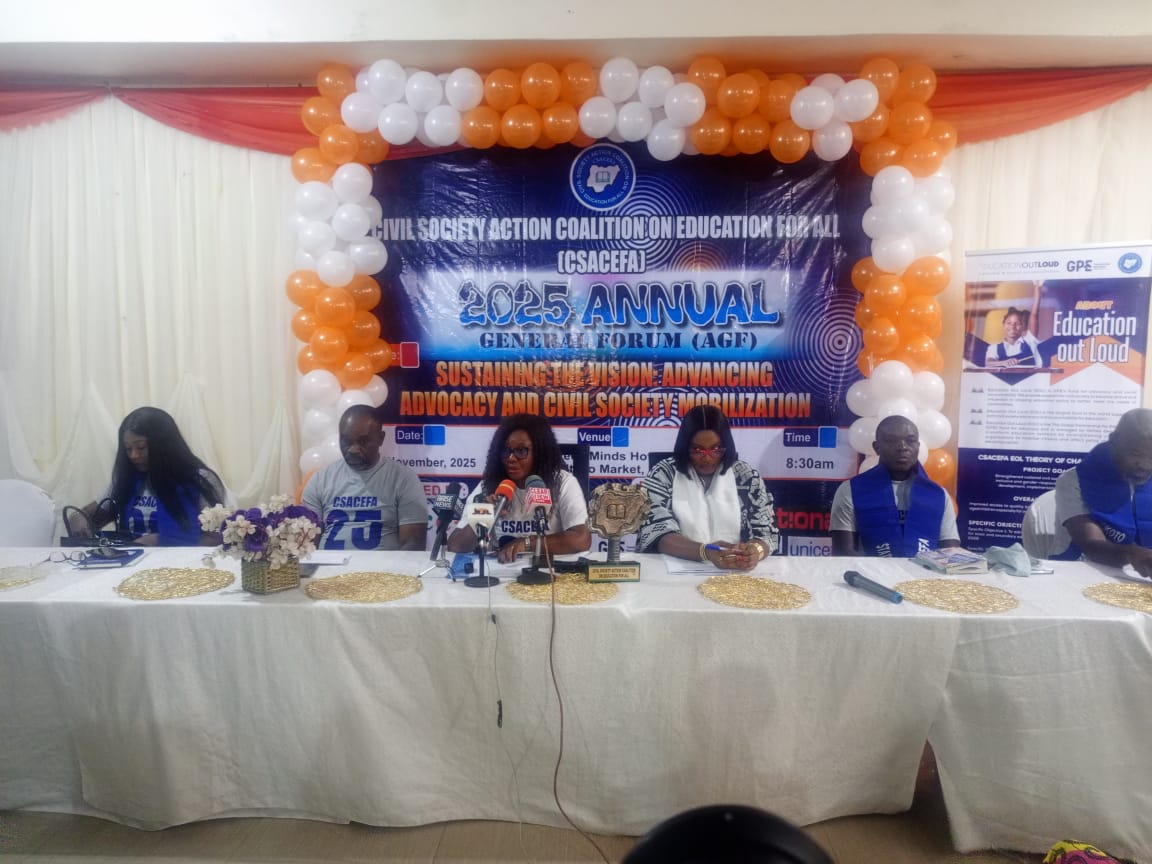
Civil Society Action Coalition on Education for All (CSACEFA) has called on relevant authorities to be proactive in fighting the recent widespread insecurity across the country to a standstill, as the country is becoming increasingly unsafe for the Nigerian children to learn.
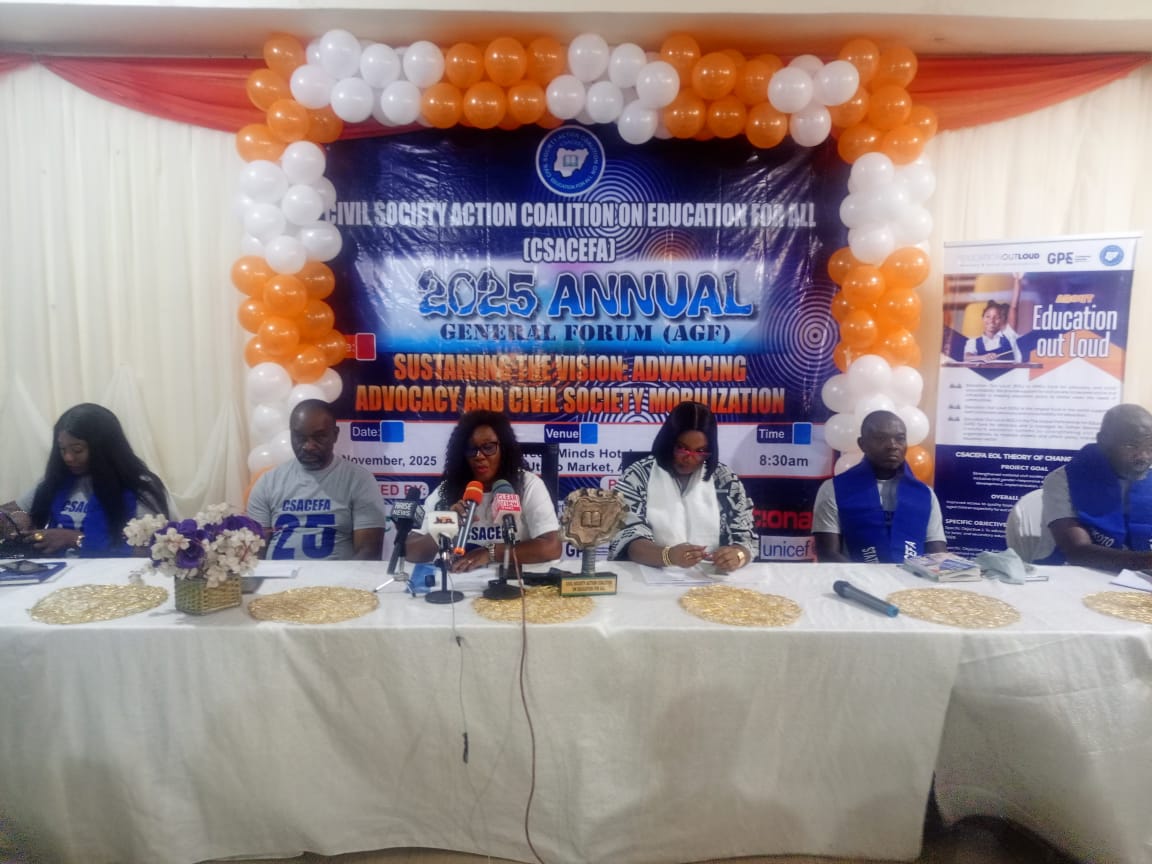
The Coalition speaking at a Press Briefing organized for its 25th anniversary and Annual General Forum in Abuja yesterday, highlighted several key areas of concerns that need swift intervention by the federal government and other relevant agencies which include the negative impacts of the recent abduction of innocent schools children in Kebbi, Niger and Kano States to mention but a few.
According to the Press Statement signed by the Coalition: “In November 2025, two major incidents occurred back-to-back:
25 schoolgirls abducted in Kebbi State
303 students and 12 teachers kidnapped at St. Mary’s Catholic School, Niger State.
“As of September 2025, 589 schools were closed across northern Nigeria due to fear of attacks and abductions.
“These attacks expose children to trauma, exploitation, sexual violence, and death. Schools—supposed to be safe havens—have become places of terror and uncertainty.
“We ask: How many more children must be abducted before Nigeria secures its schools? How many parents are now afraid to send their children to school?
“The escalating insecurity is already forcing families to withdraw their children and compelling the government to order temporary school closures.
“This is effectively rewarding the agenda of bandits and insurgents who want to keep Nigerian children out of school.
“CSACEFA condemns these attacks and calls for immediate, coordinated action by all security agencies to operationalise the Safe Schools Declaration beyond paper commitments.
The coalition also decried the poor and declining Education financing, stated that its impact has impeded the standard of education in Nigeria based on UNESCO reports.
“We must remind the government of its commitment made during the 2021–2025 financing campaign—to progressively increase education funding. Instead, the trend shows the opposite. Federal Education Budget (2023–2025)
- 2023: ₦1.09 trillion (4.99% of total budget)
- 2024: ₦2.364 trillion (8.21%)
- 2025: ₦3.52 trillion (≈7.3%)
Despite the increase in nominal terms, the percentage allocation remains far below the 15–20% UNESCO global benchmark. States’ Education Spending:
- 2025 state budgets for education: ₦2.41 trillion
- Actual spending: Only ₦1.61 trillion (66.9% implementation)
- National Education Spending (FG and States)
- Total public allocation to education in 2025: ≈ ₦5.93 trillion
This is grossly inadequate for a country of over 200 million people, with more than 50 million school-age children.
It is worrying that as Nigeria’s national budget increases, the proportion allocated to education shrinks. We cannot achieve the Renewed Hope Agenda or the 2030 SDGs without reversing this trend.
The Coalition further raised concerns on rising number of Out-of-School Children (OOSC).
“It is unacceptable that Nigeria continues to record some of the highest number of out-of-school children globally, particularly at the basic and secondary levels.
“According to UNICEF, 18.3 million children out of school at basic level (primary and JSS) (UNICEF/UBEC).
10.2–10.5 million at primary school age
8.1 million at junior secondary school age
18.5–20 million children aged 6–18 are out of school nationwide (UNESCO & UNICEF estimates).
CSACEFA classified the major drivers of out-of-school children challenges as follow:
- Early marriage and adolescent pregnancy
- Insecurity forcing school closures
- Child labour due to economic hardship
- Hidden fees in “free basic education”
- Distance to schools, poor infrastructure, gender stereotypes
- Limited inclusion of children with disabilities
“At this rate, Nigeria risks having an entire generation of children who may never access education, trapping communities in perpetual poverty, insecurity, and inequality”
CALL TO ACTION:
Nonetheless, the coalition has urged the Federal Government, State Governments, development partners, and all education stakeholders to:
1. Operationalise the Safe Schools Declaration urgently:
- Deploy trained security personnel to vulnerable schools
- Establish community-based early warning systems
- Strengthen coordination among military, police, NSCDC, and local actors
- Reopen and secure the 589 closed schools across northern Nigeria and all the 41 federal unity schools, we also call on the Niger state government to do same.
2. Increase education financing to at least 15% of annual budgets;
- Ring-fence funds for basic and secondary education;
- Ensure states fully access and utilise UBEC matching grants; there is a N62bn unaccessed UBEC funds by states, these funds could have been channeled for the provision of infrastructures for schools.
- Prioritize teacher recruitment, training, welfare, and deployment: Nigeria teachers are still very poorly paid, limiting their ability to engage in continuous teachers capacity development training.
- Expand investment in infrastructure, WASH, digital learning, and inclusion; except for unity schools, most of the states schools are in poor conditions occasioned by the lack of staff rooms, desk and toilets
3. Launch an Emergency National Programme on Out-of-School Children:
- Scale community enrolment drives
- Abolish illegal school fees and hidden charges
- Provide conditional cash transfers to poor families (AGILE)
- Expand girls’ education interventions
- Invest in inclusive education for children with disabilities
4. Strengthen Education Governance & Accountability:
- Empower SBMCs and community structures
- Improve transparency in budget execution
- Strengthen Educational management information system, Nigeria Education management System (EMIS/NEMIS) for credible, real-time data.